
This new idea is off to a good start, and the post about Sheep Hills (BMX jumps) in Costa Mesa is the runaway favorite post so far. Thanks for checking this blog out everyone! I'll try to keep it interesting.
The Team Soil video from 1995, produced by "Barspinner" Ryan Brennan, featuring the main riders of the SHL (Sheep Hills Locals) posse from that era. There are several jumping spots in this video, Sheep Hills has the small, brushy trees all around the jumps.
A long time ago (OK, 30 years or so), in a place far, far away (Costa Mesa, California) a weird tribe of mound builders evolved (OK, probably DEvolved, but that's more fun). This crew began to build small earthen mounds in an obscure area of small brushy trees and oil wells between Huntington Beach and Costa Mesa, California. These weren't the Adena people or some other culture like that, they didn't build Cahokia or the Great Serpent Mound of Ohio. Their mounds were not built to track the stars, they weren't built for religious ceremonies, or as a burial site for the dead. This group of small mounds, originally built mostly by guys then known as Hippy Jay and Hippy Sean, built mounds to jump BMX bikes, get air, learn tricks, and just plain have fun.
Jay told me he originally called the jumps Hollywood, after pro racer "Hollywood" Mike Miranda, who had built a few jumps further up the hill, where the condos off of 19th street and Balboa boulevard in Costa Mesa are now. But not long after riders started showing up, kids started calling the area Sheep Hills. So even Hippy Jay doesn't known where the name came from.
The Costa Mesa mesa itself was a place where shepherds raised sheep and goats in the 1800's, and maybe early 1900's, and the Goat Hill Tavern (141 beers on tap!),up in Costa Mesa, pays homage to that. But in reality, no one knows where the name Sheep Hills came from, even they guys building it in the beginning. There were no sheep in the area when they began building in 1990, but the name stuck.
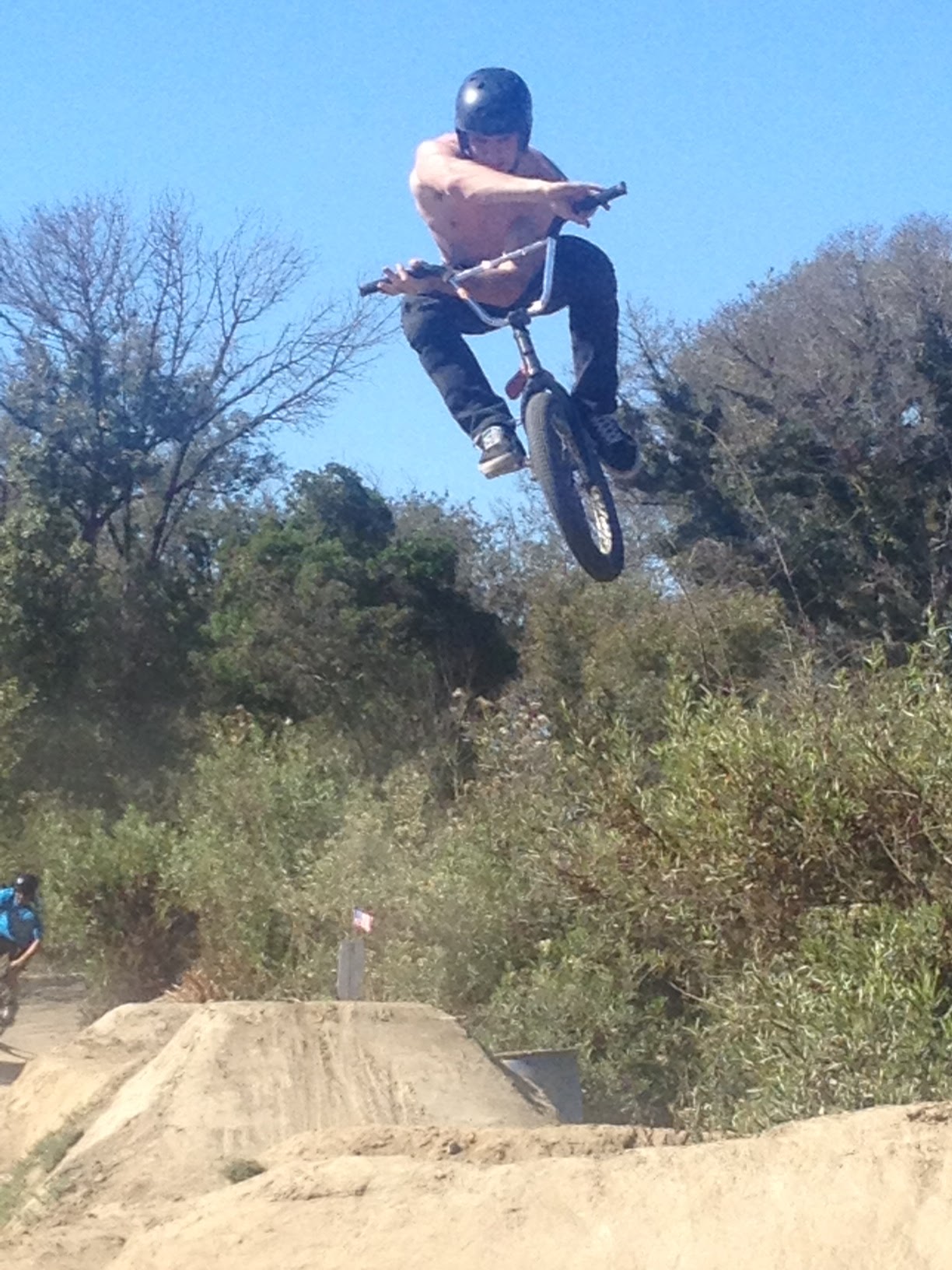
An unknown rider boosts a clean X-up over the Boozer pack at Sheep Hills. I just asked on Facebook again, to try and identify this rider, a couple guys thought it was Jody Donnelly, but it's not him. Let me know if you know who this is, so I can name him here. #steveemigphotos
One big problem with BMX dirt jumps is that they usually get built on someone else's land, then the land owner gets pissed, or worried about liability issues, and the jumps get plowed. When Sheep Hills was built, it was deep in a chunk of unused oil company land, surrounded by small, brushy trees, in a hidden meadow area between the Santa Ana River and Costa Mesa. A few homes on the surrounding mesa could see the jumps, but most seemed to ignore them. At the time, dirt jumping was not really a sport itself, but usually an event held at some national BMX races to stoke the crowd.
The top jumpers at the time were led by Chris "Mad Dog" Moeller, and his roommates at a house in Westminster, called the P.O.W. House. That stood for Pro's Of Westminster. Chris, Dave Clymer, John Paul Rogers, Alan Foster, Lawan Cunningham, Eric Millman, John Salamne, Jay Lonergan, and a few others, along with builders Jay, Sean, and Mike "Boozer" Brown, were the first guys to session Sheep Hills on a regular basis. The first set-up of jumps were three berms, one inside the other, each line with jumps in it. Transfers were possible between the lines. Sheep Hills was one of the jumping areas these guys rode often, along with Hidden Valley and Edison in Huntington Beach, and the jumps in the P.O.W. House backyard (seen at 33:50 in this video, followed by footage of the Edison High jumps).

Long time Sheep Hills local in the late 90's, Cory "Nasty" Nastazio, lays a flat tabletop 360 out at Sheep. 2020.#steveemigphotos
Before Sheep Hills came along, teenage jumpers Chris Moeller and Greg Scott were frustrated by how many bikes they were bending and breaking while jumping. They found a welding shop, and had a couple of their own, custom designed frames made in 1987. That launched the garage company S&M Bikes, which has had strong ties to Sheep Hills since, sponsoring many of the local riders from the early 1990's on. S&M, and sister company Fit Bikes, are still a major force among Sheep Hills riders.
When the trails were new,you had to cross the creek on rocks, then follow a rabbit-sized foot trail back to the jumping area. A video cameraman I worked with at Unreel Productions, (which was up on the mesa above and west of Sheep) Pat Wallace, told me a four foot long alligator was once found in the creek there. I've never been able to prove that story, but it wouldn't surprise me.

In the first few seasons of Sheep Hills, the winter rainy season would flood the whole area, and the jumps would turn to unrideable muck, from December into March. Every spring, they would be rebuilt. There was a natural bowl in the beginning, which had a jump in and jump out. That was about where the trench leading into Titties (it's the name of the jump folks, don't get mad at me) is now. At one point, there was a line of doubles along the fence, up by the pond, which you can see in a couple shots in the Team Soil video above. There was a ten pack along the left side for years (as you walk in from the Hamilton side entrance).
K.O. D. (King of Dirt) was the big jump in the mid 90's, built to practice for the "huge" jumps at jumping contests. It's a 7 foot tall big set of doubles, followed by a roller, and another big set of doubles. K.O.D. is still there, though Titties has taken over at the main style jump. Stephen Murray built a four foot high, 27 foot gap et of doubles, called The English Channel, at one point.
The jumps at Sheep went largely unnoticed, which is what BMXers like, until they accidentally drained the nearby pond with a pump, sucking it out to water the jumps. I think that happened in 1993 or 1994. The trails into Sheep got widened out, so police cars could roll through, among other reasons.
A bunch of local kids started jumping there in the early 90's, and they evolved into the Sheep Hills Locals, aka SHL crew. Ryan "Barspinner" Brennan, Sean Butler, Josh Stricker, Freddy Chulo, Jason and Adam Pope, Marvin Loetterle, Mike "Boozer" Brown, Jason "Dogger" German, Ricky Ratt, and Mental Ian were the main guys in that posse. At the same time, Alan Foster's little brother, Brian Foster, moved to California from the East, and became another key member of both the P.O.W. House, and the SHL crew. "Religious Rich" is another long time local there, as well.

This second wave of riders out of Sheep Hills came up the ranks, some as racers, and some as jumper/street/riders, in the mid 1990's, just in time for the X-Games, the dirt jumping as it's own sport. Through the late 1990's, Sheep Hills was known as the home trails of many of the best BMX dirt jumpers in the world, and became a travel destination for riders from around the country, and around the world. In the late 1990's and early 2000's, it wasn't unusual to ride into Sheep and meet riders from the U.K. or Germany or Japan, just there to check it out and ride a little.
Several other top riders made Sheep a daily riding spot in the late 90's. Cory "Nasty" Nastazio, Chris Duncan, Stephen Murray, and top racer Christophe Leveque ushered in a new era of Sheep locals. As the years passed, Sheep Hills became better and better known, and the area was eventually turned into Talbert Regional Park of Costa Mesa. Now there's a sign there, trash cans that actually get emptied, and wide trails for riding mountain bikes, jogging, big wheeled stroller pushing, and just walking.
The once sketchy, largely hidden BMX spot, is now a family area used daily by the neighbors living nearby, as well as many visitors. It's really unusual that a set of BMX trails can last 3 or 4 years without getting plowed, but Sheep Hills has somehow managed to last 30, and is going into it's fourth decade (damn we're old).

Sheep Hills can be found on Google Maps, or look up "Balboa boulevard, Costa Mesa" on GPS, that's where many people park these days to go ride. Go down the hill, and follow the trails with the most bike tracks, and you'll find the jumps.
This post is dedicated to three Sheep Hills Locals. Mike "Boozer" Brown was paralyzed in a BMX crash several years ago, and died in 2019. Stephen Murray was also paralyzed several years ago on a double backflip try, and Bryant "Doc" Dubon was tragically lost to Covid-19 in 2020. Ride in Peace Mike and Bryant, and Stay Stong Stephen Murray (now back in the U.K.).

The pits area during a big jam. Good bikes, good friends, good fun. That's BMX. Sheep Hills 2020. #steveemigphotos
You can check out more of my photos of Sheep Hills on my Pinterest page. (160 photos and counting...)

Close-up of one of the murals on the sides of The Rose Theater, on Magnolia, in North Hollywood's NoHo Arts District. The indie theater is one of five that have closed due to the loss of business during the Covid pandemic.
About three weeks ago, I picked up a copy of the San Fernando Valley Business Journal, and it had an article about how hard the pandemic hit the NoHo Arts District. I lived up in this area for a year in 1991, when the arts district was just getting started. Seriously, the area was pretty ghetto. Now, 30 years later, the area is really vibrant. The Red Line train stop sits among hundreds of apartments, it's a largely young crowd, 20 and 30-somethings, many commuting to L.A. area to work on the train, pre-pandemic. There are a ton of cool restaurants on Lankershim and in the surrounding area.
But when you walk through the area, you don't see much of "the arts" in the typical, visual way. There are not rows of galleries, like say in Laguna Beach, down in Orange County. The arts in the NoHo arts district has been theater, 22 small, independent theaters. North Hollywood, according to the SFV Business Journal article, actually has, or had, the second highest concentration of theaters in the U.S., only the Broadway/off Broadway Theater District in New York City has more.

The front of The Rose theater in NoHo Arts District.
As the pandemic-induced business shutdown hit businesses at all levels, it was particularly devastating to the small theaters of the NoHo Arts District. They struggled, they got some help from the city of Los Angeles, and from patrons. But independent theaters operate on a very tight margin to start with, and rents were already becoming an issue for them before the pandemic.
The problem with arts districts everywhere is that artists move into a cheap, run down area, and they create art. That begins to attract other artists, and eventually a hip art scene evolves. In the scenes where it takes off, that attracts art enthusiasts, and eventually more business, and later apartments and restaurants and other retail stores. Rents go up, and eventually the artists that sparked new life in the area get priced out of the arts district. Covid put that into high gear. That leads us, as a society, to ask this question:
Do we want to have arts in our arts districts indefinitely?

Another mural from the walls of The Rose Theater.
Or do we want to let this 20-30 year cycle keep playing out over and over, in the cities and towns where solid art and creative scenes actually do build, and begin to flourish? That's a bigger issue to mull over as we head forward. For now, five of the 22 indie theaters that made the NoHo Arts District an arts district, are closed. That's a big hit to all the creative people, and jobs, that depended on those theaters attracting people to the area.
I'm not a huge theater fan, I've been to an indie theater once. But I'm creative guy, an artist and a writer/blogger, and I get that actors become good, and great actors... by acting in front of people. It's no accident that these 22 theaters were in North Hollywood, sandwiched between the TV and movie studios of Burbank and Studio City. The main studio owner interviewed in the SFV Business Journal article was the owner of the 68 Cent Theater Company, on Lankershim. That theater now has a For Lease sign on it.
Creative people create stuff. Good stuff. Bad Stuff. Weird stuff. Art, sculptures, music, plays, books, movies, TV shows, video games, and yes, even blog posts. This creation has re-vitalized many parts of many towns and cities in the U.S., and around the world. So this post is to shine a light on a theater in North Hollywood that has gone dark, and to get us all thinking about the huge role the arts, of all kinds, plays in our lives, our world, and the livelihood of our towns and cities.
After all, what did all of you do during the shutdown? You consumed a TON of other people's creative works, and you probably made a little of your own on social media. Artists are "Essential Workers," we kept you all from going bat shit crazy for the last year. Think about that as we open back up. What kind of town or city do you want to live in?


Don't let the heart of creativity stop beating. #steveemigphotos
This little known 1975 skateboarding movie shows skaters under the Huntington Beach Pier (1:44), skating the pier bank, which was on the north side of the pier, and the open area on the south side (now outside dining area).
Why was skateboarding invented? So surfers could "surf" sidewalks and streets when the waves were flat. Reportedly the first skateboard was made around 1958 in San Diego, some say other times and places. I'll leave that argument up to skate historians. The first big wave of skateboarding happened around 1965-66, and faded, leaving a few hardcore types skating during the down years. By 1975, the year of this film, the wave of popularity was building again. From 1:44 to about 3:00 in the video above, you can see skateboarders (including a couple Zephyer kids- the Z-Boys- in blue shirts), skating the pier bank, and Russ Howell and a couple others skating the south side area. For 30 years or more, the Huntington Beach Pier attracted skateboarders almost daily.
The 1970's skateboard wave lasted longer than the first wave, and led to quite a few skateparks being built in Southern California, and some other parts of the country. I caught that wave myself, as a little kid in Ohio, buying my first board in 1976, like tens of thousands of other kids nationwide. The handstands and 60's freestyle tricks gave way to the surf style of the Z-Boys, which led to backyard pools and vert skating. But the wave of popularity crashed, and a larger number of hardcore skaters went underground, and sessions kept happening at the H.B. Pier.
The pool skating of the late 70's led to the birth of quarterpipe and halfpipe ramps, which made vert skating demos and contests possible in places with no pools. Here's a Christian Hosoi in 1986, at a contest on a halfpipe right on the sand, with the H.B. Pier in the background.
This is Pierre Andre' Senizergues, French freestyle skating champion, and founder of Etnies (Sole Technology), skating at the Huntington Beach Pier in 1989.
Freestyle skateboarding made a comeback, and by the mid-1980's, freestyle skaters Pierre Andre' from France, Don Brown from England, and Hans Lingren from Sweden, and H.B. local Jeremy Ramey, were locals at the H.B. Pier. They all skated for one of the Vision Skateboards brands out of Costa Mesa, which included Sims and Schmitt Stix skateboards. Per Welinder, a freestyle skater from Germany came by on a regular basis, so did Bob Schmelzer, and Costa Mesa local Darryl Grogan could be seen skating at the pier from time to time. By that time, there were big posts in the pier bank, and a huge chain across the bank, blocking skating. That chain mysteriously vanished in 1989 (pretty sure aliens took it, ; ) ), and a lot of great sessions went down on the bank that year.
I was a BMX freestyler who rode with these guys on the weekends in that era, and pretty much anyone in skateboarding might show up in those days. Street skating was just morphing into its own genre' then, and Mark Gonzales and then up-and comer Ed Templeton cruised regularly. There was a whole posse of local H.B. street skaters, which included Jason Lee, now best known as an actor (My Name is Earl, The chipmunks movies, etc). I saw Natas Kaupas there once, Ray Barbee once or twice, and many others.

Freestyle skating died out again in the late 80's, and street skating was the new wave building in the skateboard world. The freestyle skater locals still skated some by the pier, but Pierre and Don got busy running Etnies Shoes, which grew into Sole Technology, putting out Etnies, E's, Emerica, and Sheep shoes over the years, as well as 32 snowboard boots, and Altamont clothes. They are now located in Lake Forest, next to the huge Lake Forest skatepark the company built for the city.
Skateboarding in association with the annual U.S. Open of Surfing started happening in the 1990's, and continues. Pools and courses are built annually, right on the sand by the H.B. Pier. As I write this in May 2021, things were on hold with the Covid pandemic over the last year, but will resume again. Here's the last big on the sand skate event, the Van's Rebel Jam in 2019. While the history of skating at the Huntington Beach Pier doesn't go back as far as fishing or surfing, there have been skaters skating there over for over five decades now, and likely many more to come.
This is a great 8 minute look at the history of competitive surfing at the Huntington Beach Pier. But surfing in Huntington Beach actually goes back to 1914 with George Freeth, one of the Hawaiian surfers that brought back "The Sport of Kings."
Riding waves on wooden boards goes back hundreds of years in Hawaii, or the Sandwich Islands, as they were called by haoles when first discovered. But when the white settlers started colonizing the islands, they didn't catch the surf stoke, and did what they could to ban the sport. Surfing was all but dead in the later half of the 1800's. A small group of watermen in Waikiki, around 1900, started bringing the ancient sport back. A half Irish, half Hawaiian named George Freeth was the leader of the crew, among them a young man a few years younger than George, Duke Kahahamoku.
In about 1907-08, writer Jack London, best known for his novels about the Klondike gold rush, like The Call of the Wild, and White Fang, traveled to Hawaii. Walking out on the beach in Waikiki, London saw some men who appeared to be "walking on water." He kept watching, and realized they were riding the waves on long boards. London was fascinated by this activity, and got to know them and learn about their life as surfers, swimmers, and divers. When he went back to the mainland, London wrote an article about surfing for a U.S. women's magazine.
That article was read by the wife of Southern Californian railroad magnate Henry Huntington, among many others. At the time, Huntington had run a railroad arm down to Redondo Beach from Los Angeles, and was having a pier built, and developing the land there. The Huntingtons traveled to Hawaii soon after, and met George Freeth and his crew of surfers in Waikiki. Henry Huntington hired Freeth to come to California to do diving and surfing demonstrations at the Redondo Beach Pier to help promote the development and sell houses there.
In the years that followed, George began to surf other breaks as well around southern California. Along the way, George invented the idea of lifeguards at beaches, and the lifeguard "can" or buoy, used to help bring tired swimmers to shore. He helped train the first lifeguards at SoCal beaches.
Meanwhile, farther south in Orange County, some developers had started a small community called Pacific City, which was supposed to be the Atlantic City of the West Coast. But they had trouble attracting people to the small town, surrounded by lima bean fields. The Pacific City developers decided to talk Henry Huntington into building a railroad trolley line from Long Beach to Pacific City, to make it much easier to visit. To seal the deal, they changed the name of Pacific City to Huntington Beach in the railroad man's honor. It worked. And in 1914, when a new pier was dedicated in Huntington Beach, George Freeth gave the very first surfing demo at the Huntington Beach Pier. The wave riding tradition that would turn Huntington Beach into "Surf City" had begun. Unfortunately, George Freeth died in the Spanish Flu pandemic of 1917-1919, getting sick after a daring rescue.
Duke Kahanamoku, in the same time period, had become a champion Olympic swimmer, and began to promote surfing around California, and later all around the world. From the 1910's until his death in 1968, he promoted surfing, and spread the stoke worldwide, becoming the Father of Modern Surfing.
In 1920, oil was discovered in Huntington Beach, and it turned into a somewhat rowdy oil town. In a weird quirk of fate, as other cities around it got developed in the next few decades, including houses built right on the beach, Huntington Beach lagged behind. Because of this, it became the less expensive, more working class beach city in Orange County. The oil wells, crazy as it sounds, kept the 8.3 miles of beach from getting developed, leaving H.B. with the best beach for local beach goers in SoCal. The consistent, if not huge, beach break waves, and the less expensive rent, attracted plenty of surfers. When the surfing, surf music, and "beach blanket" surf movies exploded in popularity in the early 1960's, Huntington Beach became known worldwide as Surf City. That led to the explosion of surfing culture, and great competitions documented in the video above.
In August of each year, the U.S. Open of Surfing, the successor to the OP Pro contests of the 1980's-1990's, draws crowds of 100,000 or more people, and the best surfers on Earth. A statue of Duke Kahanamoku now stands in front of Huntington Surf & Sport, surrounded by hand prints and foot prints in cement of the top surfers of recent decades.

Back to the Online Guide to Hollywood
Finished in 1956, this iconic building was built to house the Capitol Records west coast business operations, and recording studios. It's located on Vine street in Hollywood, just north of Hollywood boulevard. The 13 story building was the first circular office building, and the first record recorded there was one of Frank Sinatra reading tone poems. The needle on the roof has blinking light that blinks "Hollywood" in Morse code. The building has been blown up and attacked by aliens in several movies, and appears in two Grand Theft Auto video games, and Tony Hawk Wasteland. There's a long mural by Richard Wyatt, Jr., on a wall just south of it (towards Hollywood blvd.) that pays homage to American jazz music. Capitol Records was founded in 1942, bought by EMI in 1955, and became part of the Universal Music Group in 2012.
At 1:11 in this video, you see three skaters carving through the Sheep Hills Ditch in Costa Mesa, California. I think it's Marty "Jinx" Jiminez, Tom Groholski, and Mark Gonzales, but I'm not sure. Vision Psycho Skate came out in 1988, and I worked as a PA in their video company, Unreel Productions, at the time. I didn't have any input on the video, Brian Gillogly directed that one.
While not much different than hundreds of other ditches across the American West, this ditch just happened to be a few blocks from the cluster of buildings that housed Vision Skateboards and Vision Street Wear clothes, in the mid and late 1980's. It was not a place that got sessioned daily, but a lot of skating went down there over the years, and it appeared in Psycho Skates in 1998, and also in the intro of Vision's Barge at Will in 1989, at 1:59. You can see the brushy trees of the area that later became known as Sheep Hills (BMX jumping trails) in the background.
While not crazy skating trick-wise, these two clips, and the really cool longer segment of the Poway ditches at 2:59 in Barge at Will, got skaters everywhere looking for local ditches to carve at speed. There are all kinds of ways to have fun on a skateboard, and ditch skating drew in both the vert skaters that were the most respected genre of skating then, as well as the street skaters, which was a new and emerging aspect of skateboarding, at the time.
As a BMX freestyle guy working at a skateboard video company then, I made VHS copies of all the raw skateboard footage coming in from Vision video shoots. So I got to watch skate footage at work, before anyone else saw it, which is pretty cool. Even better, I found out where a lot of cool spots and some empty pools were from all the skaters. Someone in Vision, I can't remember who now, told me there was a mini-ramp hidden somewhere in the brushy trees and bushes "down 19th street" in Costa Mesa. So I started heading down there after work, wandering around, looking for this ramp. A lot of skaters still hated BMXers then, so the person didn't tell me the exact spot. That was probably mid 1998.
One of the first things I found down there was this long ditch, with the round elbow you see in the clips above. While not a great bike jump, the inside hip was fun to bunnyhop air after carving along the ditch, and I started hitting this ditch on my ride home from work now and then. I never did find the hidden mini-ramp, it was somewhere else, I guess. But I did some wandering around that area of empty, oil farm land. There were a couple small jumps down there, next to the creek some BMXer had made. Our cameraman, Pat Wallace, said someone found a 4 foot long alligator in the creek there once, but I could never find a news report to back that up.
In late 1990, a couple of local BMX guys, known as Hippy Jay and Hippy Sean then, found an open meadow in the middle of the trees, and began to build the jumps soon known as Sheep Hills. The area is now officially Talbert Regional Park, and much to everyone's surprise from the early days, the Sheep Hills jumps are now not only still there, but famous worldwide due to so many famous jumpers riding there in the 1990's. The S&M Bikes riders/P.O.W. House (Pros of Westminster) guys, led by Chris Moeller, Dave Clymer, John Paul Rogers, and several others, sessioned Sheep Hills regularly in the early 1990's. Those guys inspired the next generation, the Sheep Hills Locals crew of Sean Butler, "Barspinner" Ryan Brennan, Freddy Chulo, Josh Stricker, Marvin Loetterle, Jason and Adam Pope, and several more. In the years after, Cory Nastazio, Chris Duncan, Christophe Leveque, Stephen Murray, and many more honed their skills at Sheep.
I did not. as a freestyler who sucked at jumping doubles, after the days of the 3 berms, Sheep was beyond my skill level. So I wandered around doing really dumb street shit like BMX nollies, 6-7 foot half Cabs, and stuff. Like those tricks would ever be popular. Silly me.
By the time the X-Games came along in 1995, the SHL posse riders, who included Alan and Brian Foster by then, were some of the leading BMX dirt jumpers in the world. Sheep Hills became known in the BMX world as one of the spots where a whole slew of great jumpers rode daily. Once in a while a couple might hit the ditch for a little session, but it was mostly a skate spot hit randomly. Vision Skateboards moved its headquarters to Santa Ana in 1990, to the old OP building on Lyon Street, and this ditch has sat there, largely ignored ever since, I imagine.
These days, mountain bikers and parents with strollers wander the trails around the area, and BMXers and mountain bikers jump at Sheep Hills, and the ditch still sits there, draining water in the winter like it's supposed to, largely forgotten by everyone. Like every ditch, officially, you're not supposed to skate there. It's pretty rough concrete, so if you do go check it out, safety gear, especially knee pads, is a real good idea. There are a lot of flat trails around there for mountain biking as well, great beginner level or recreational riding.

My photo of one end of the Sheep Hills Ditch, you can see the elbow part that's in the skate videos at the very end. The Talbert Regional Park, is located off Balboa Street in Costa Mesa, at the bottom of the hill at the very west end of 19th Street. The Sheep Hills jumps are about 100 yards away. #steveemigphoto
Here's a short, 3 1/2 minute video, showing some of the Monterey Bay Aquarium, by David Hill Photography. This give you a quick, and we...


