Tuesday, August 24, 2021

The Oceanview flyout BMX jump


This is my 1990 self-produced bike video, The Ultimate Weekend.  Go to 23:21 in this video for the segment at the Oceanview jump.  

In 1990, BMX was in a crazy period.  The sport had "died" in 1989, as major corporations pulled out of the 1980's "fad" of BMX racing, and the new trick riding thing called BMX freestyle.  The bike industry itself decided in 1989 that BMX was "over" and pulled their support away from all things BMX, and plunged their money into mountain bikes, which are, of course, adult sized BMX bikes.  Nearly all freestylers in the 80's raced for a while, before getting into freestyle.  But BMX racing was racing, and most racers did some dirt jumping.  Freestyle, the trick riding aspect of the sport, had evolved a separate type of bikes, heavier, with framestanders and axle pegs.  By late 1990, when this video came out, flatland and quarterpipe contests had existed for six years, halfpipe contests for 3 years, and street contests for only 2 years.  Wall rides had only been a thing for 3 1/2 years.  Flatland riding evolved into scuffing then into forward rolling tricks, led by Kevin Jones and the Plywood Hoods.  It was fading in popularity, but more difficult than ever.

Vert riding was going from quarterpipes to halfpipes.  There were no concrete skateparks... ANYWHERE... in California.  I think Kona in Florida was the only one left.  This video was the first to have mini-ramps in it, they were a brand new thing that skaters had started making.  Street riding was the new trend, and most BMX videos by bike companies still had riders wearing leathers.  The sport of BMX freestyle had gone underground, the posers were gone, and the progression of the sport was happening at a fast pace.  Guys like Mat Hoffman and Dennis McCoy didn't even have factory sponsors at times in 1989.  The world had left BMX for dead, the money was gone from the sport.  But we kept riding... and progressing.

Jumping had been a part of BMX riding since the very beginning, starting with kids on Schwinn Stingrays in the early 1970's. But by 1990, there were two schools of jumping.  Racer/jumpers preferred double jumps,with some distance involved, and their tricks were mostly one handers, and one hand one footers, things like that.  Hardly any racers could do 360's.  The exception were the crazy young guys on the S&M Bikes team, a garage company at the time, led by Chris Moeller.  They were pushing the level of jumping to new highs, and crazier tricks.  

The other kind of jumping at the time was freestyler jumping, usually on flyout jumps.  Some were ditch jumps where you rolled in one side, and out the other.  Some flyout jumps were where you pedaled to a tall jump, 6-7 feet high, and popped straight up.  Freestyle jumpers didn't go far, or very high, but these jumps gave you hang time over a flat landing, time to try really weird new tricks.  So while the racers were jumping farther and higher, freestylers were jumping smaller, but working more on weird new tricks.  In time, the two types of jumping blended, and the trails riders that emerged in the early 1990's took the freestylers' crazy tricks, like 360's, one hander no footers, nothings, and tailwhips, and soon after backflips, and did them bigger, over doubles.  

Throughout 1990, the Oceanview flyout jump in Huntington Beach was one of the places a bunch of the Orange County based riders would show up and push the limits of new tricks.  This jump was in the front yard of Oceanview High School in Huntington Beach, at the corner of Warner and Gothard streets.  I'm not sure who built it, but it was the perfect place.  We had a concrete runway to a 6 1/2 high jump to flat, under the shade of this huge tree.  The recent new Jersey immigrant, and hungry and then unknown rider, Keith Treanor, flat out ruled Oceanview at the time.  That's why a silhouette of Keith jumping over John's upstretched arm was on the cover of this video.  

The riders in this segment are Keith Treanor (23:32), John Povah (23:36), GT vert pro Josh White (23:49), recently retired pro Woody Itson (23: 51), and H.B. local flatlander Andy Mulcahy (24: 03).  As small as this jumping seems in today's world, this was cutting edge freestyle jumping for its day.  No handers, one hand no footers, and nothings were all pretty new tricks, very few people were trying them.  When this footage was shot, decade jumps had not been invented yet, and no one had done a tailwhip on dirt, as far as we knew.  The tailwhip attempt that Josh White runs away from in this clip he followed by landing his first tailwhip on dirt ever.  My camera battery died, and it shut off, while he was in the air.  I missed the shot of Josh White's first tailwhip.  Right about the same time, the Spring of 1990, Mike Krnaich landed a tailwhip on a tiny box jump, and that became the first tailwhip jump ever in a video, when the Bully Bikes video came out.  Josh wanted to kill me for missing the shot of his first tailwhip, and I never saw him out jumping again, so I never got that shot.  

So, as small as this jumping seems in today's world, the sessions that happened almost every night at the Oceanview High flyout jump in 1990, were really pushing the new tricks in jumping at the time. The four or five sessions I shot video of, combined in this clip, recorded those tricks, and motivated riders of the day to push the limits of jumping even farther.  In the P.O.W. House and Edison section inthis video, you can see the racer/jumpers like Chris Moeller, Dave Clymer and Mike " Crazy Red" Carlson.  Right around that time, jumping contests at some BMX races were starting to happen, which began to turn dirt jumping into its won genre' of BMX.  

And just for the record right before this clip, at 23:17, you see a guy doing a double peg grind on a ledge.  That's me, and that shot, to the best of my knowledge, it the 2nd double peg street grind ever in a BMX video, and the first on a ledge.  In Ride Like a Man, produced by Eddie Roman for 2-Hip, which came out a couple months before my video, Dennis McCoy does a double peg grind on a rail next to a walkway.  My grind here is the second double peg grind in a video.  And later in this video, Keith Treanor does the first double peg grind down a rail over a small set of stairs, and John Povah does the first ice pick grind on a rail.  That's how new street riding was then, fundamental tricks were being invented all over in that era of 1989-1991, and every video had some "first ever" tricks back then.  

In the many years since 1990, Oceanview High School became a big skating spot in the 1990's, and "The Ashtray," the first public skatepark in California, was built a couple hundred yards away in Murdy Park.  Later on, the high school did a major expansion, and built over the area where the flyout jump used to be.  But this spot was one that helped pushed new tricks in BMX in the late 1980's and early 1990's, adding to the evolution of BMX during the "dead" years of the early 1990's.

If you look through this gate, there's a window back there, about five feet off the ground.  That's about where the Oceanview flyout jump used to be.  This is the 20,000 or so square foot addition to the front of Oceanview High School. #steveemigphotos
This is the front of Oceanview High School now, looking from the corner of Warner and Gothard.  The big tree next to the jump was about where the building is now, about the center of this photo.  #steveemigphotos.


So 

Sunday, August 15, 2021

The Alley Studios building


At 5066 Vineland in North Hollywood, there's a boarded up storefront.  For 43 years, that building was home to The Alley rehearsal and recording studios.  Bands rented it by the week.  Kind of like Fight Club, the first rule was not to tell anyone about it.  The next rules were no photos, no film, no videos inside... ever.  From 1973 to 2016, bands rehearsed there, and recorded albums there.  It was called The Alley, studio and rehearsal hall.  

It doesn't look like much from the outside.  Musicians entered from the alley in the back, hence the name, The Alley.  Michael Jackson recorded four albums here.  Prince recorded two.  Jackson Browne told owner Shiloh he wrote her favorite song, "For Everyman," in this building.  The Alley was there and in operation long before the area became North Hollywood's NoHo Arts District.  #steveemigphotos

 Don Henley once said that the epic Eagles song, "Hotel California," was about the transition from innocence to experience."  The Alley was a place for artists to hide out, and be artists.  Sex, drugs, and rock 'n roll, and all that it meant to be a big band in the 1970's, and beyond, happened inside this building.  Legend has it that the scene at the Alley was the initial inspiration for the Eagles writing "Hotel California."  As best anyone can tell, over 1,800 hits were written or recorded in the non-descript building.  The piano that was in the rehearsal studio until 2020 is said to have belonged to Gram Parsons.  The Red Hot Chili Peppers auditioned 3,000 guitar players there in the 1990's, before going with Dave Navarro, who they'd pretty much already settled on anyway. 

Three Dog Night.  Paul McCartney.  Bob Marley. Tom Petty,  Motorhead, Frank Sinatra, Etta James, Fleetwood Mac.  Little Feat.  Warren Zevon.  Crosby, Stills, Nash, and Young.  Deep Purple. Jackson Browne.  The Eagles.  Black Sabbath.  Santana.  Stevie Wonder.  Roy Orbison.  K.D. Lang.  Bonnie Raitt.  Sheryl Crow.  Nirvana, Smashing Pumpkins.  The Interrupters, Lucinda Williams, and on and on.  Hundreds, probably thousands, of the greatest musicians of the last 50 years practiced, wrote, hung out, jammed, and recorded music in this building.  Even in Hollywood, The Alley studios were legendary, but a secret at the same time.  The Alley was a place where musicians could be musicians, close off from the outside world, and let the magic happen.

To top it off, there are even ghost hunters who have put the building on TV.  At least one man died there, in a fall down the spiral staircase.  Supposedly there are ghost cats roaming the building as well.  

The brick walls with the musician and band signatures would probably go for tens of thousands of dollars to rich collectors if pulled out and sold.  Sometimes the great places in history are hiding right in plain sight.  Like Diagon Alley in Harry Potter, you had to be one of the chosen, the hardcore musicians, to enter this building between 1973 and 2016.  

It started in 1965, and a biker named Bill Elkins came there to shoot photos of Three Dog Night in 1972.  All of his friends were musicians and Harley type bikers.  He just had to own the place, and waited for it to go up for sale.  When it finally did, he tore down the For Sale sign so no one else would see it, and called the owner.  Bill bought the building, and started using scrap lumber he scrounged to build it into a rehearsal hall and recording studio in 1973.  He met Shiloh in the 70's, they married, and lived in the small apartment at the back of the property.  He built the business with word of mouth from band to band, musician to musician.  That kept the place busy for 43 years, from 1973 to 2016.  Bill died in 2015, and Shiloh died in 2017.  The Alley closed in 2016.  They had no children, so there were no heirs to pass it on to.  

One time Alley technician, John Strand, tried to get The Alley going again, but had financial and other issues, and had to sell it.  Here are a couple of the better videos that do exist from The Alley Studios.

2015 interview with Shiloh Elkins by a young woman from Ghost Cult Magazine -22 minutes

Spectrum News 1 (L.A.) News report from 2020- 4 1/2 minutes

Recording "Crying" with Roy Orbison and K.D. Lang at The Alley 

The music video: "Crying" Roy Orbison and K.D. Lang ( music/vocals partially recorded at The Alley)

Save The Alley video- 2019

Little Feat playing "Long Distance Love," believed to be in The Alley in the 1970's.

Red Hot Chili Peppers jamming in The Alley in 1990 

Ghost Adventures promo in The Alley- 2019


Friday, July 30, 2021

Slab City: That last lawless place in the U.S.?


Actors Emile Hirsch and Kristen Stewart talk about shooting their duet scene at "The Slabs" for the 2007 movie Into the Wild.  The movie, based on a John Krakaur book, is about Christopher McCandless, an smart student and athlete, who wandered away from society seeking his own answers, and eventually died in Alaska.  This scene was actually shot at Slab City.

I was talking to a friend who's into off road racing trucks, about this blog.  I said something like, "You go out to Ocotillo, right?  Have you ever been out to the big metal sculptures at Borrego Springs?" He said he had, and I told him I wrote a blog post about those.  We got talking about the Southern California desert, and I told him about the legends of the ship in desert.  He hadn't heard that legend, but it sounded interesting.  Then he said, "and there's that lawless place out there, too, by the Salton Sea."  I wasn't sure what he was talking about.  Then it clicked, "Slab City?"  He said that was the place.  That seems to be the way people think of Slab City, those who have heard of it, or maybe visited it, it's "that lawless place."  

Slab City got its name because there are a whole bunch of concrete slabs out there, making nive flat places to park a camper, or built your own house of some sort in a place no one really cares about.  At least most of the time.  The slabs are the remnants of a retired Marine Corps camp's gunnery range.

I first heard about Slab City in the movie Into the Wild.  I later read the book, and it stuck in my mind.  I was working as a taxi driver in Orange County in 2007, and once or twice a week I'd go see a movie in the early afternoon, as much to escape the heat as to watch any particular movie.  Into the Wild was one of the most fascinating movies I saw back then.  

I was living in my taxi, working 7 days a week, 16-18 hours most days, just struggling to pay my $550 a week taxi lease.  The idea of wandering off into the wild sounded pretty good at the time.  The taxi business was going downhill, due to the computer dispatching system, which allowed taxi companies to put far too many cabs on the road for the amount of business that existed.  

On Thanksgiving weekend, 2007, I finally hit the point where I wasn't going to make my lease by the next Monday.  Totally burnt out, grossly overweight, and not sure what to do with my life, I decided to take a drive that Sunday morning.  My goal was to find Slab City, just to check the place out.  I didn't work that Saturday night, I felt kind of sick.  So I woke up about 4:00 am.  I headed south on the 5 freeway, and then east on route 78.  Around dawn, I pulled off in a little area in the Anzo Borrego State Park, and took a short hike on a trail there.  I got back in my cab, and headed east, until I hit route 86, on the west side of the Salton Sea, California's largest lake, and one of the craziest stories in the state.  But that's a tale for another day.

I had a computer in the pawn shop, that I bought just to edit video with, but I never got on the internet then, so I had no idea exactly where Slab City was, I just knew it was somehwere near the Salton Sea, which is like 30 miles long.  I drove north, got some breakfast near a casino, and asked a couple people where Slab City was.  I went out to the edge of the once popular, now dying Salton Sea, where the bones of millions of dead fish scatter the shore.  I headed south, taking tips from a local, but never found Slab City.  It was getting hot out, so I headed back up to Orange County.  

The next morning I dropped off my taxi at the company, simply dropped the keys at the window, and walked away with my small backpack and about $15.  My health was so bad, after three bouts of cellulitis in my legs that year, that I didn't expect to live more than a few weeks on the street.  I wound up living on the streets of Orange County for nearly a year.  

I've still never been to Slab City. I saw a cool TV show where some skaters went out there and built a mini skatepark, and skated for a few days.  There are several videos on YouTube about the place, I'll link some below.  

The basic story is that the place was built as Camp Dunlap, a Marine Corps training base in 1942, during World War II.  It was functional and used for three years, then dropped down to a skeleton crew.  According to Wikipedia, the big area of concrete slabs was part of the artillery range.  When it was abandoned, a few drifters set up camp there.  A few more came along, and it became a squatters community of people moving in and out, including many snowbirds from northern areas, coming in the winter.  The Department of Defense gave the land to the state of California in 1961 officially.  

Slab City is pretty close to the middle of fucking nowhere, which is a great place to go if you want to "get away from it all."  It's east of the southern end of the Salton Sea, off route 111, near Niland.  It's in Imperial county, part of the Sonoran desert, and temperatures can reach a toasty 122 degrees F in the summer.  

It's generally seen as a place where the government didn't care about, so people could live  cheap with basically no laws.  Anarchy in the desert.  Since I've found it interesting, but never been there, I'll let the people from Slab City tell their stories, in the links below.  I also recommend the movie Into the Wild, and The Salton Sea (which is about meth,so MAJOR trigger alert if you're a recovering tweeker).

Last Free Place in America (52 minutes)

Inside Slab City (from Vice- 22 minutes)

Lawless Slab City (The Roi's VLOG 21 minutes)

The Real Local resident of Slab City (2021- 37 minutes)

Exploring East Jesus- Slab City (12 minutes)

Salvation Mountain (9 minutes)

You can help support this blog, and my other creative work on Patreon.

Become a Patron!

Wednesday, July 28, 2021

Crazy California 43's Guide to Huntington Beach

The Huntington Beach Pier at dusk.  #steveemigphotos

Huntington Beach was an oil well filled, mellow surf town, with the only long stretch of wide open beach in SoCal, when I moved there in 1987.  As many cities struggled for a variety or reasons, H.B. kept growing and getting more and more built up and developed.  Most of the old oil pumps have been taken down, and the wells capped, and it's a bustling beach town for trendy people now.  But it hasn't totally forgotten its action sports roots.  Since I live din H.B. for the better part of 20 years, several of the early posts in this blog are locations in Huntington Beach, starting with the iconic pier.  Here are links to my posts about H.B., more posts will be added as time goes on.

Classic Surf Spot: The Huntington Beach Pier

Classic Skate Spot: The Huntington Beach Pier

Classic BMX Spot: The Huntington Beach Pier

The Ashtray: the tiny skatepark that made all public skateparks in California possible 

Lloyd Wright's tombstone... for an idea 

 Huntington Beach jail cells from the 1920's

Classic BMX Spot: Sheep Hills  (OK, technically Costa Mesa, but it's on the border) 

Classic BMX Spot: The Old Surf Theater parking lot 

Classic BMX Spot: The Blues Brothers Wall 

The Duke Kahanamoku statue in front of Huntington Surf & Sport, on the corner of PCH and Main in downtown Huntington Beach.  #steveemigphotos


Tuesday, July 27, 2021

The original Wahoo's Fish Taco in Costa Mesa

The first Wahoo's Fish Taco, at 1862 Placentia, in Costa Mesa, California.  #steveemigphotos

I first heard of Wahoo's Fish Taco restaurant in 1988, right after this first one opened.  I was working at Unreel Productions, the video company owned by Vision Skateboards at the time.  Skateboarding was reaching the peak of its third wave of popularity, and Vision Skateboards and Vision Street Wear clothes were selling like crazy.  A lot of really talented young people were working at the various Vision businesses, spread around several buildings, and anchored by the Vision main office at 17th and Whittier in Costa Mesa.  This first Wahoo's above was a few blocks from the Vision buildings, and as soon as it opened, Vision workers started hanging out there after work.  

Right after it opened, someone came by Unreel from Vision, and told me I should come hang at Wahoo's after work.  I've never been a big seafood person, and fish tacos seemed weird to me then.  I was totally wrong about that, their fish tacos are great.  But it took me a decade to figure that out.  I never went to Wahoo's to hang with the Vision crew people.  My loss.

Inside the original Wahoo's Fish Taco on Placentia, in Costa Mesa today.  #steveemigphotos

So I finally visited this first Wahoo's restaurant last week, intending to meet a friend from Norway, and a few others, in town for the X-Games.  From the start, Wahoo's have taken the Baja California fisherman's meal, based on fresh caught fish in tacos and rice, and blended it with a hardcore action sports world vibe.  The walls and ceilings of Wahoo's are covered in surfboards, skateboards, BMX bikes, photos, posters, stickers, and artwork form surfing, skateboarding, BMX, and other action sports.  They have that "chillin' by the beach when the waves are flat" vibe.  Casual, fun, and hanging with friends and good food before or after going riding, skating, surfing, or snowboarding.  

Vintage Vision Psycho Stick skateboard on the wall of the Costa Mesa Wahoo's.  Few people know (or remember), that Psycho Man, the guy on this skateboard, was a real person who worked in the Vision Skateboards Art department in the late 1980's.  He was actually a cool guy, I met him a couple of times.  But he had a crazy style, and unique look, so they put him on a skateboard which turned into a hot seller.  #steveemigphotos

In more recent times, the last couple of years, I learned that old BMX freestyle friend, Ron Camero, a former Vision freestyler, is the guy who decorates all the Wahoo's restaurants.  He contacted me when he saw some of my BMX Sharpie Scribble Style drawings, and wound up buying several to put up at different Wahoo's restaurants.  There are none in the original Wahoo's, but my drawings now hang in several other Wahoo's.  

Here's one of my Hugo Gonzalez prints, in the Wahoo's in Los Alamitos, I believe.  

You can also find my Sharpie art on the walls of Wahoo's in Torrance, the Long Beach Marketplace restaurant, San Clemente, and Las Vegas, I believe.  So a huge thanks to Ron  Camero to adding my drawings to the walls of the coolest taco place in and around Southern California.  The food is good, the beer is cold, and there's a laid back, fun vibe to every Wahoo's.  If you are into any of the action sports, or just like tacos (that's pretty much everybody, right?), you need to check out a Wahoo's Fish Taco. Yeah, I'm overselling it, and believe it or not, this is NOT a paid post.  I'm just stoked to have some of my art up at Wahoo's around the region.  

One of my Krys Dauchy drawings up at a Wahoo's.  Photo: Ron Camero
Dave Vanderspek/Curb Dogs drawing up at a Wahoo's.  Photo by Ron Camero.

Another Hugo Gonzalez drawing, up at a Wahoo's (top left).  Photo by Ron Camero. #sharpiescribblestyle

Disclosure:  Yes, I've sold several drawings to be hung in Wahoo's Fish Taco restaurants, several months ago.  There was no deal for me to write a blog post in exchange for those sales.  When I visited the first Wahoo's last week, I snapped some pics, and decided to do a blog post. 


Monday, July 19, 2021

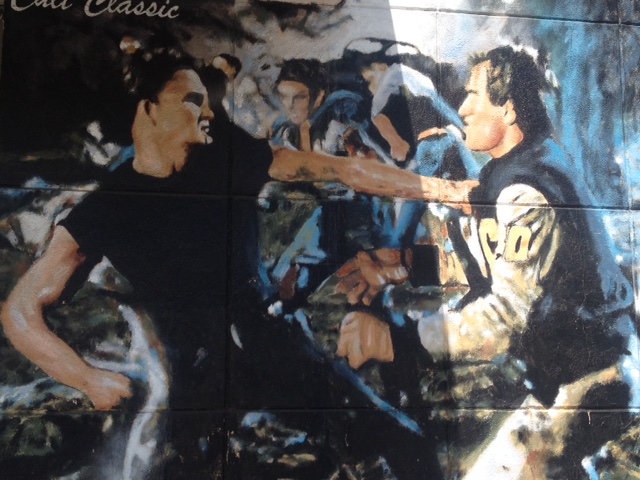
"Stay Gold" (from The Outsiders) mural in Sherman Oaks

One of the cult classic movies for Generation X people, like myself, the 1983 movie The Outsiders is known for several scenes, but the standout is Ponyboy and Johnny's "Nothing gold can stay" scene, which you can see here.  This is a close-up of a mural on the side of Floyd's barbershop, at 13601 Ventura Boulevard in Sherman Oaks, in the San Fernando Valley.  #steveemigphotos
The Outsiders is also remembered for giving most people their first look at several soon-to-be major actors of that generation.  C. Thomas Howell, Ralph Macchio, Matt Dillon, Rob Lowe, Emilio Estevez, and Patrick Swayze all appear in major roles.  Until doing reserach for this post, I didn't realize that Tom Cruise, Diane Lane, Leif Garrett, Tom Waits, and a very young Sophia Coppola (Francis Ford Coppola's daughter and Spike Jonze' ex) are also in the movie.  Imagine the budget it would take to get that cast in a movie today.  #steveemigphotos
The thing I love about this shot is that shadow line when I took it, sort of visually reinforcing the dark side of the social spectrum, Patrick Swayze leading the Greasers, and the popular kids, in the light, the Soc'es (Soshes?).  Here's the classic rumble scene from the movie.  #steveemigphotos
Here's the mural from the other angle.  #steveemigphotos
 

Saturday, July 17, 2021

The Iliad Bookshop in North Hollywood

I like big books, and I cannot lie...  The exterior of Iliad Bookshop in North Hollywood.  #steveemigphotos

If you are a serious reader, and particularly one interested in movies, TV, film history, acting, photography, or the arts in general, Iliad Bookshop, in North Hollywood, is a place you must get to.  I've been a big reader since I learned to read, way back in the dark ages, and loved going with my dad to used book shops to wander among the stacks, and find that one perfect book for that time in my life.  Or maybe 10 perfect books.  

When I first moved to North Hollywood in 1991, after stumbling into the mainstream TV/video production world, I found Iliad at its former location, right on the X-shaped intersection of Vineland, Lankershim, and Camarillo streets.  Odyssey Video rental store was next to it then, a big yellow building.  That's where the name came from, a little literary joke, the used bookshop next to Odyssey must be named Iliad, right?  The owners thought so.  

If you're a book geek like me, you might also believe heaven (if there is one), looks something like this.  Until we get there, there's Iliad Bookshop to check out.  Floor to ceiling shelves of books.  Everything you see in this photo is part of the movie/film section.  #steveemigphotos.

Iliad Bookshop has moved from that original location, and is now located at 5400 Cahuenga Blvd., in North Hollywood, the cross street is Chandler.  If you're a bike rider, you can actually take the Chandler Bikeway from the Red Line train station in North Hollywood straight to Iliad, and save some gas.  I actually walked there from the train station, and I'm fat.  It's less than a mile walk.  

Iliad is home to two cats, Zeus and Apollo, who have a fan club of their own, people come in just to see the cats.  So leave your service rhinoceros or service llama at home, service dogs only, if needed.  Iliad is also home to about 150,000 used books.  Real, paper books.  You can wander the stacks, and find books on almost any subject.  Their sections of books on movies, TV, acting, dance, music, art, and photography are ginormous, the biggest selection of these subjects that I've ever seen in any used book store. There's a huge selection of novels, and tons of graphic novels.  Most every standard subject is represented, except business oriented books.  If you're looking for epic used paperback novels, they have tons.  I walked away with Robert Heinlein's Sci-Fi classic, Stranger in a Strange Land, on this trip, which is almost impossible to find in a used bookstore these days.  

Iliad Bookshop sits on the corner of Cahuenga and Chandler in NoHo, and the blue background, street facing walls, are covered in murals of dozens of literary legends, and famous scenes from books, plus the huge books in the top photo.  #steveemigphotos

If you're a book lover or avid reader anywhere in Southern California, you need to put a trip to Iliad Bookshop on your reader bucket list.  In addition to the huge selection inside, there are almost always boxes of donated books, available for free, outside the main door, which is in the parking lot.  I found a copy of Dan Brown's Angels & Demons on this trip, in the free boxes.  These are the donated books not needed in the store itself.  So if you like to read, are looking for that hard to find book, or just want to wander the huge stacks of a real, old fashioned used bookshop of epic proportions, head to Iliad Bookshop.  I might see you there.


The Monterey Bay Aquarium

Here's a short, 3 1/2 minute video, showing some of the Monterey Bay Aquarium, by David Hill Photography.  This give you a quick, and we...